

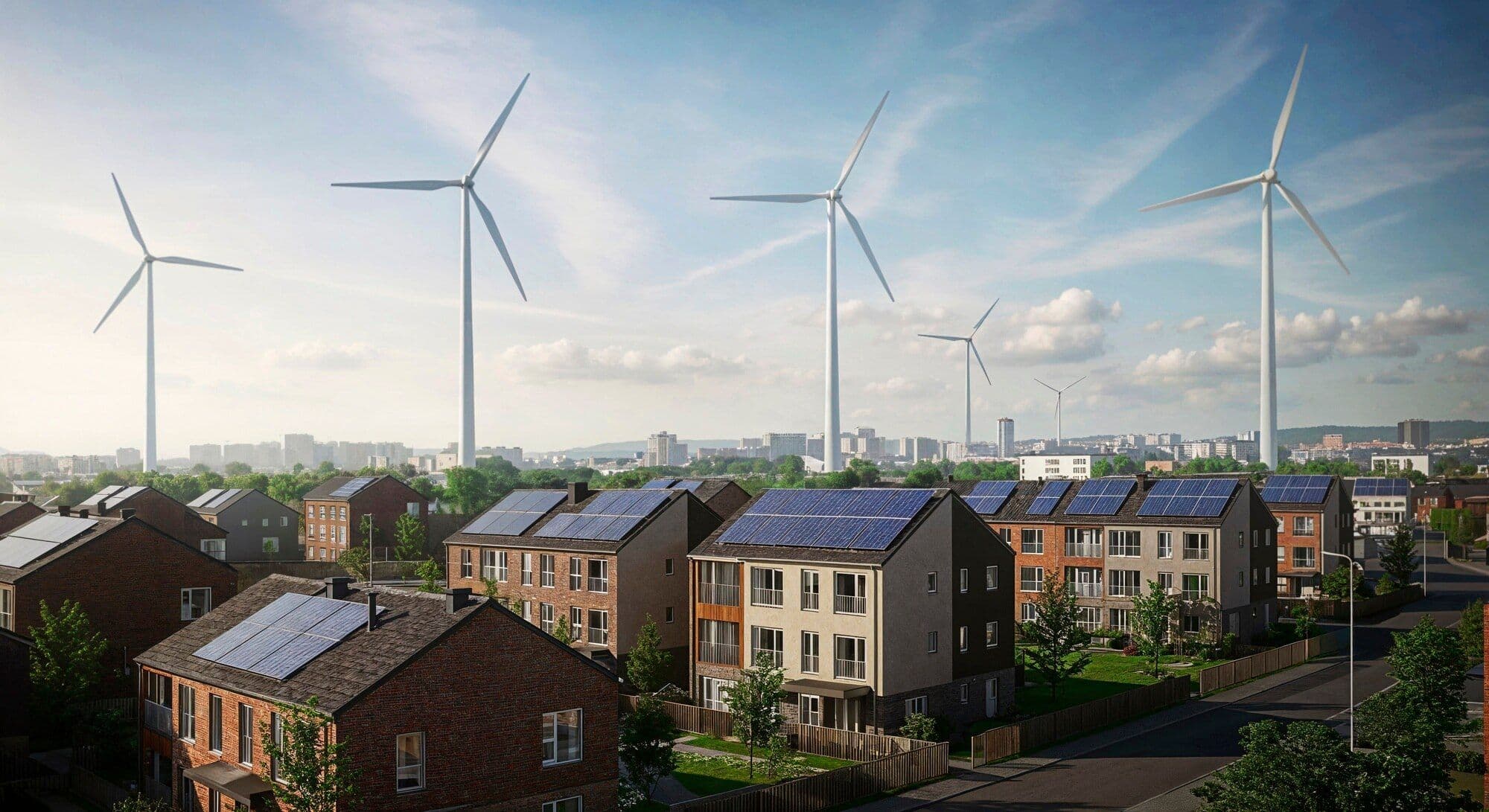
When discussing building energy efficiency, attention often focuses on air-conditioning systems, lighting, solar panels, and other energy-efficient technologies.
However, one of the most fundamental factors is often overlooked: the building materials themselves.
The materials used in walls, roofs, floors, windows, and other components of the building envelope determine how heat moves between the interior and exterior. As a result, material selection can have a direct impact on indoor thermal comfort, HVAC demand, energy consumption, and long-term operating costs.
For buildings in hot and humid climates such as Indonesia, this becomes particularly important.
Why Building Materials Matter for Energy Efficiency
A building is constantly exchanging heat with its surroundings.
During hot weather, heat from the outside can enter the building through the roof, walls, windows, and other parts of the envelope. At the same time, conditioned air inside the building can lose energy through the same pathways.
The HVAC system must compensate for these heat gains and losses to maintain the desired indoor temperature.
This creates a simple relationship:
More unwanted heat transfer → Higher HVAC load → Higher energy consumption
Conversely:
Less unwanted heat transfer → Lower HVAC load → Greater energy efficiency
The materials and construction systems used in the building envelope therefore play an important role in controlling this heat transfer.
Understanding Thermal Conductivity
One of the most important properties when evaluating building materials for thermal performance is thermal conductivity, commonly represented by the Greek letter λ (lambda).
Thermal conductivity indicates how readily heat passes through a material.
In general:
- Lower thermal conductivity → Better resistance to heat transfer
- Higher thermal conductivity → Greater heat transfer
However, thermal conductivity alone does not tell the complete story.
The thickness of the material and the way it is incorporated into a building assembly also matter.
From Thermal Conductivity to R-Value
The R-value, or thermal resistance, describes how strongly a material or building assembly resists heat flow.
A higher R-value generally indicates greater resistance to heat transfer.
For a simple homogeneous layer, thermal resistance is related to material thickness and thermal conductivity:
R = thickness / thermal conductivity
This means that both the material itself and its thickness influence thermal resistance.
However, real buildings consist of multiple layers rather than a single material.
A wall may include exterior finishes, structural components, insulation, air cavities, interior boards, and other layers. The thermal performance of the complete wall therefore depends on how all these components work together.
Understanding U-Value
Another commonly used parameter is the U-value, which describes the rate of heat transfer through a building component.
Unlike R-value, where higher values generally indicate better insulation, a lower U-value generally indicates better thermal performance.
In simplified terms:
Higher R-value = better resistance to heat transfer
Lower U-value = lower heat transfer
These parameters can help architects and engineers compare the thermal performance of different building assemblies.
The Building Envelope as the First Line of Defense
The building envelope separates the conditioned interior from the outdoor environment.
It typically includes:
- Exterior walls;
- Roofs;
- Floors;
- Windows and glazing;
- Exterior doors; and
- Other enclosure components.
The envelope plays a critical role in controlling heat gain and heat loss.
In a hot climate, an effective building envelope can reduce the amount of solar and ambient heat entering the building.
This can reduce the cooling load required from the HVAC system.
For example, consider two buildings with identical floor areas, occupancy levels, lighting systems, and HVAC equipment.
If Building A has a poorly insulated envelope while Building B has a high-performance envelope, Building A may require significantly more cooling to maintain the same indoor temperature.
The difference is not necessarily the HVAC system.
It may begin with the building envelope.
Walls and Their Impact on Energy Consumption
Walls represent a substantial portion of the building envelope.
The thermal properties of wall materials and the configuration of the wall assembly influence the rate at which heat enters or leaves a building.
A high-performance wall system may incorporate materials with low thermal conductivity, appropriate insulation thickness, reduced thermal bridging, and carefully designed joints.
The objective is not simply to select a material with a low λ-value.
The complete wall assembly must be designed to provide the required thermal resistance under actual operating conditions.
This is an important distinction between material performance and building-system performance.
Roofs Can Be a Major Source of Heat Gain
Roofs are particularly important in tropical climates because they are directly exposed to solar radiation.
A roof with inadequate thermal protection can transfer significant amounts of heat into the building.
Strategies for improving roof performance may include:
- Appropriate insulation;
- Reflective or high-performance roof surfaces;
- Ventilated roof assemblies;
- Reduced thermal bridging; and
- Proper detailing of joints and penetrations.
Improving roof performance can help reduce the cooling load and improve indoor thermal comfort.
Windows and Glazing
Windows can be one of the weakest parts of a building envelope from a thermal-performance perspective.
Large areas of glazing can allow solar radiation and heat to enter a building, particularly when windows are not properly oriented, shaded, or specified.
High-performance glazing can help control solar heat gain while still allowing daylight into the building.
Depending on the project, designers may consider factors such as:
- U-value;
- Solar Heat Gain Coefficient (SHGC);
- Visible light transmittance;
- Glazing type;
- Frame performance; and
- External shading.
The objective is to balance daylight, views, thermal performance, and energy consumption.
Thermal Bridging: The Hidden Weakness
Even when high-performance insulation is used, heat can bypass the insulation through conductive paths known as thermal bridges.
Thermal bridges can occur at:
- Structural connections;
- Columns and beams;
- Slabs;
- Window frames;
- Wall intersections;
- Fasteners; and
- Other penetrations.
These areas can reduce the effective thermal performance of the building envelope.
Therefore, achieving energy efficiency requires more than selecting high-performance materials.
It requires good detailing and installation.
Materials and HVAC Performance
The relationship between material selection and HVAC energy consumption is particularly important.
The HVAC system is responsible for maintaining the desired indoor temperature and humidity conditions.
If the building envelope allows excessive heat to enter the building, the HVAC system must remove that additional heat.
This can increase:
- Cooling capacity requirements;
- Operating hours;
- Electricity consumption;
- Equipment wear; and
- Operating costs.
Improving the thermal performance of the envelope can therefore reduce the burden placed on HVAC systems.
This does not mean that better materials automatically eliminate the need for air conditioning.
Rather, they can help the HVAC system operate under more favorable conditions.
Energy Efficiency in Hot and Humid Climates
Indonesia presents a particularly interesting environment for building energy efficiency.
In many parts of the country, buildings face high temperatures, strong solar radiation, and significant humidity throughout much of the year.
Cooling can therefore represent a major component of building energy consumption.
For such buildings, thermal design should focus strongly on controlling heat gain.
Material selection can support this objective through:
- Low thermal conductivity;
- Appropriate insulation;
- High-performance glazing;
- Reflective surfaces;
- Reduced thermal bridging; and
- Well-designed building-envelope assemblies.
However, material selection should always be integrated with orientation, shading, ventilation, HVAC design, and building operation.
Material Selection and Life-Cycle Cost
Energy-efficient materials should not be evaluated solely according to their purchase price.
A material with a lower initial cost may require more energy during the building's operational life.
Conversely, a higher-performance material may require a greater initial investment but reduce energy consumption year after year.
This leads to an important concept:
Initial Cost ≠ Life-Cycle Cost
A more comprehensive evaluation should consider:
Material Cost → Installation → Energy Consumption → Maintenance → Replacement → End of Life
For long-term building assets, energy savings over decades can be considerably more important than the initial difference in material cost.
Measuring the Impact of Material Selection
The effect of material selection can be evaluated using measurable building-performance indicators.
Depending on the project, these may include:
- Thermal conductivity (λ);
- R-value;
- U-value;
- Solar Heat Gain Coefficient (SHGC);
- Energy Use Intensity (EUI);
- HVAC cooling load;
- Annual electricity consumption; and
- Indoor thermal comfort.
Building energy simulation can also help designers compare different envelope configurations before construction.
For example, a project team could simulate several wall systems and evaluate how changes in thermal resistance affect annual cooling demand.
This provides a more reliable basis for decision-making than simply choosing materials based on their marketing descriptions.
Beyond Energy: The Multiple Benefits of High-Performance Materials
One of the most interesting aspects of high-performance building materials is that a single material or building system may contribute to several objectives simultaneously.
For example, a wall system designed for high thermal performance may also provide:
Thermal Insulation
↓
Reduced heat transfer
Acoustic Insulation
↓
Improved sound control and privacy
Fire Performance
↓
Improved safety
Durability
↓
Longer service life
Reduced HVAC Demand
↓
Lower operational energy consumption
This integrated approach is particularly relevant for modern healthcare, commercial, hospitality, residential, and institutional buildings.
From Green Building to High-Performance Building
Traditional green building discussions often focus on reducing resource consumption and environmental impact.
That remains important.
However, the next step is to ask how the building can perform better as a complete system.
A high-performance building combines:
High-Performance Envelope
+
Efficient HVAC
+
Efficient Lighting
+
Smart Building Controls
+
Renewable Energy
+
Efficient Water Systems
+
Appropriate Materials
The building envelope is therefore not a secondary consideration.
It is one of the fundamental components of the building's energy strategy.
Conclusion
Material selection can have a significant impact on building energy efficiency.
Walls, roofs, floors, windows, and other envelope components determine how effectively a building controls heat transfer between indoors and outdoors.
By selecting materials with appropriate thermal properties and combining them into well-designed building assemblies, architects and engineers can reduce unwanted heat transfer, improve thermal comfort, reduce HVAC loads, and potentially lower long-term operating costs.
However, the best results come from looking beyond individual products.
A high-performance material is only one part of a high-performance building system.
The ultimate objective is to create buildings that use less energy, maintain comfortable indoor conditions, perform reliably over time, and deliver better value throughout their life cycle.
In other words, energy efficiency does not begin with the air conditioner.
It begins with the building itself.